|
|
◆ WZggglm2()
| Function WZggglm2 |
( |
N As |
Long, |
|
|
M As |
Long, |
|
|
P As |
Long, |
|
|
A As |
Variant, |
|
|
B As |
Variant, |
|
|
D As |
Variant |
|
) |
| |
General Gauss-Markov linear model (GLM) problem of complex matrices (complex numbers in pairs of cells)
- Purpose
- WZggglm2 solves a general Gauss-Markov linear model (GLM) problem:
minimize || y ||_2 subject to d = A*x + B*y
x
rank(A) = M and rank(A B) = N
minimize || inv(B)*(d - A*x) ||_2
x
To represent complex numbers, a real part and an imaginary part are stored in a pair of adjacent cells (a real part in a left cell, and an imaginary part in a right cell). The computed results are stored in the same way.
- Returns
- max(M,P)+1 x 4
| Column 1 | Column 2 | Column 3 | Column 4 |
| Rows 1 to max(M,P) | Least squares solution vector x (real part) (Rows 1 to M) | Least squares solution vector x (imaginary part) (Rows 1 to M) | Residual vector y (real part) (Rows 1 to P) | Residual vector y (imaginary part) (Rows 1 to P) |
| Row max(M,P)+1 | 2-norm of residual sum of squares (||y||2) | Return code | 0 | 0 |
Return code
= 0: Successful exit
= 1: The least squares solution could not be computed. The upper triangular factor R associated with A in the generalized QR factorization of the pair (A, B) is singular, so that rank(A) < M.
= 2: The least squares solution could not be computed. The bottom N-M x N-M part of the upper trapezoidal factor T associated with B in the generalized QR factorization of the pair (A, B) is singular, so that rank(A B) < N.
- Parameters
-
| [in] | N | Number of rows of the matrices A and B. (N >= 1) |
| [in] | M | Number of columns of the matrix A. (1 <= M <= N) |
| [in] | P | Number of columns of the matrix B. (N - M <= P) |
| [in] | A | (N x 2M) N x M coefficient matrix A of the GLM equation. |
| [in] | B | (N x 2P) N x P coefficient matrix B of the GLM equation. |
| [in] | D | (N x 2) Left hand side vector d of the GLM equation. |
- Reference
- LAPACK
- Example
- Solve a general Gauss-Markov linear model (GLM) problem, i.e. find x which minimizes || y ||_2 subject to d = A*x + B*y, where
( -0.82+0.83i 0.18-0.94i -0.18-0.12i )
A = ( -0.76-0.24i 0.57-0.16i -0.08-0.27i )
( 1.90+0.26i -0.98+0.54i 0.21+0.28i )
( 0.50-0.30i -0.31+0.37i 0.22+0.19i )
( 1 0 0 0 )
B = ( 0 1 0 0 )
( 0 0 1 0 )
( 0 0 0 1 )
( 1.7126-0.6648i )
d = ( 0.8697+0.7604i )
( -2.1048-1.6171i )
( -0.9297+0.1252i )
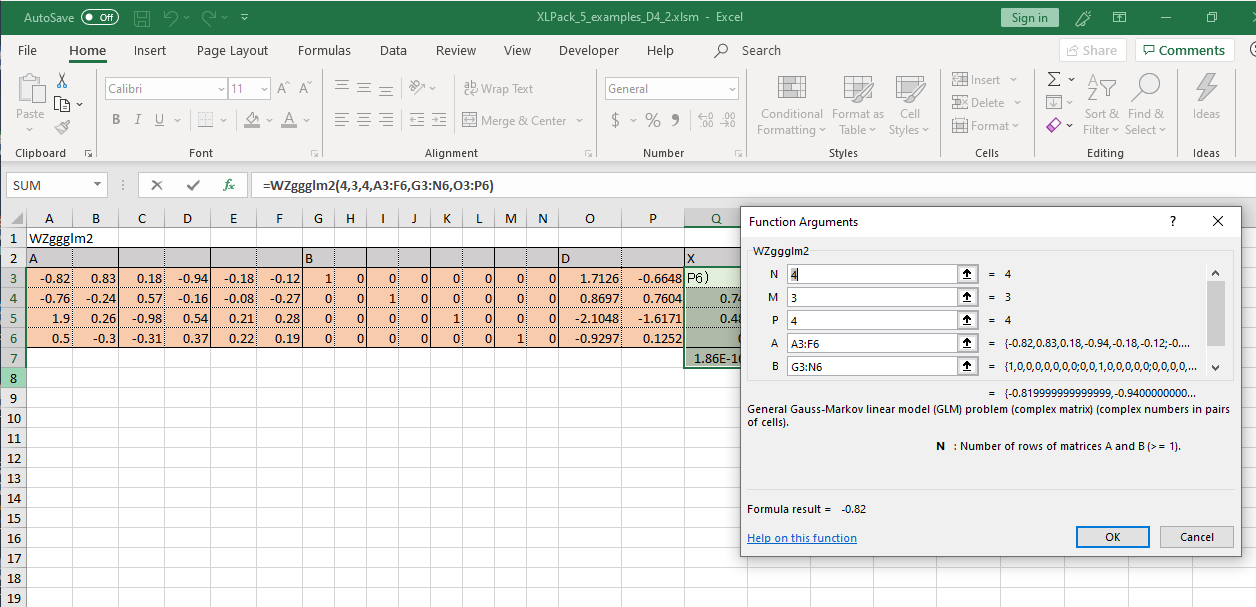
|

 1.9.7
1.9.7