|
|
◆ WAvint()
| Function WAvint |
( |
A As |
Double, |
|
|
B As |
Double, |
|
|
N As |
Long, |
|
|
X As |
Variant, |
|
|
Y As |
Variant |
|
) |
| |
Finite interval quadrature for a function with tabulated data (approximation with overlapping parabolas)
- Purpose
- WAvint integrates a function tabulated at arbitrarily spaced abscissas. The limits of integration need not coincide with the tabulated abscissas.
A method of overlapping parabolas fitted to the data is used provided that thereare at least 3 abscissas between the limits of integration.
WAvint also handles two special cases. If the limits of integration are equal, WAvint returns a result of zero regardless of the number of tabulated values. If there are only two function values, WAvint uses the trapezoid rule.
- Returns
- Computed approximate value of integral.
- Parameters
-
| [in] | A | Lower limit of integration. (A <= B) |
| [in] | B | Upper limit of integration. (A <= B) |
| [in] | N | Number of data. (N >= 2) |
| [in] | X | (N) Abscissas. (Must be in increasing order) |
| [in] | Y | (N) Ordinates (function values). |
- Reference
- SLATEC
- Example
- Using the following table, compute S = integral of 1/(1 + x^2) dx [0, 4] (= atan(4)).
x 1/(1 + x^2)
----- -------------
-1 0.5
0 1
1 0.5
2 0.2
3 0.1
4 0.05882
5 0.03846
----- -------------
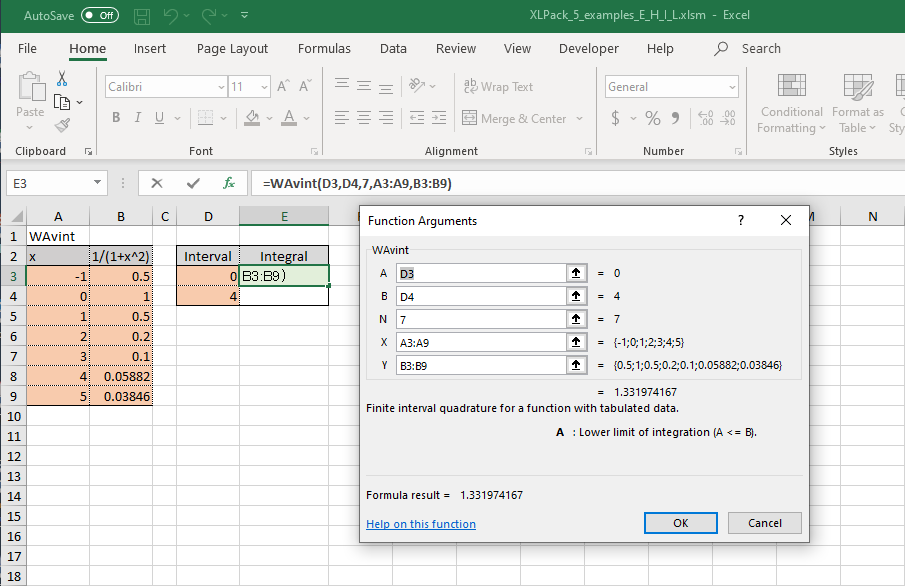
|

 1.9.7
1.9.7